

I’m going to be honest: more often than not, the state of the global climate feels bleak. Six of the nine planetary boundaries have been crossed, and governments across the world are starting to weaken environmental protections. Often, I find myself in a hopeless doom spiral, worried that nothing we can ever do will make a difference. However, since starting the master’s program in Environmental Governance and Adaptation to Climate Change (ENGO for short), I am frequently reminded that hope is not lost.
Good work is being done across the world to ensure a better future for everyone. While we may not be on target to reach most of our climate goals, that’s no reason to give up. Even modest gains and protections can help ensure a better climate for future generations.
The biggest thing I’ve learned in my first semester so far: small actions can have a big impact. Climate change is bigger than any individual. One person is not going to single-handedly solve global warming; however, many people taking small steps can lead to big, positive effects. Here are some things I’ve started doing in the first semester of my program that you, too, can take to help in the fight against climate change.

This year’s snowless Tallinn Jõuluturg, taken 23 December, 2025. A stark reminder of the effects of climate change.
Eat less (red) meat
This semester, I took a course called “Global changes in ecosystems and their impact on the use of natural resources.” One of the first seminars was about global food production and how it affects climate change. We learned that industrial animal agriculture is one of the biggest producers of greenhouse gases globally–cows are notorious for producing methane. Methane produces a powerful greenhouse effect, around 28 times stronger than carbon dioxide, the most abundant greenhouse gas. While others are certainly stronger, methane is the second most abundant greenhouse gas, causing a much larger effect in total.
Given the prevalence of methane, one of the most effective steps an individual can take is to cut meat out of their diet. For a lot of people, this can seem incredibly intimidating and I get it. As an American, I can’t imagine life without hamburgers, bacon, or hot dogs. But the good news is, you don’t have to completely cut them out. I have been particularly inspired by this interview of celebrity chef Tal Ronnen in the Los Angeles Times, where he says “Be a ‘vegan’ who eats bacon.”
If going vegan is too intimidating, try practicing Meatless Mondays. According to the University of Colorado, Boulder, by choosing one day to cut meat from your diet, you can save 133 gallons of water (503 litres) and reduce your carbon footprint by eight pounds (3.6 kilograms) — just for that one day! Imagine the accumulative impact over a year or longer. Plus, there are associated health benefits to eating less meat, too.
What I’ve done over the past three months is to cut red meat entirely out of my home cooking and only cook other animal-based proteins once per week. The rest of the time, my meals are entirely vegetarian. When I go out to eat, I don’t place restrictions on what I can order, though I’ve found myself ordering vegetarian options just as often as not. I’ve also found incredible recipes that I wouldn’t have otherwise tried, like this butternut squash and pear soup (made with veggie broth, of course).

Butternut squash and pear soup, topped with parmesan cheese—so delicious it’s been added to my list of autumn go-to recipes!
Choose public transit or walking
I’m sure you’ve heard it a thousand times: taking public transit can reduce your carbon footprint. Walking or biking is even better. If you haven’t heard that, here are some statistics. In 2019, around 25% of greenhouse gas emissions in the EU were caused by transportation. Of that, 72% was due to road transportation (cars, trucks, etc), over half of which was from personal cars. That’s a lot of carbon. By switching to public transport, you can reduce carbon emissions by 45%.
Now, I will admit that I’m fortunate. For most of my adult life, I’ve lived in places with robust public transportation systems, like Boston and New York City. Even now, as a student and resident of Tartu, I get a discount on bus fares. Plus, Tartu is one of the most walkable cities I’ve lived in. Not everyone is so lucky. Many towns, especially in suburban and rural environments, do not have well-planned and maintained public transit and are not walkable. However, even choosing to carpool with a friend or neighbour can help improve transit emissions.
If you live in a city or other urbanized area, consider ditching your car entirely. I’ve already discussed the climate benefits to taking public transportation, but walking and biking can reduce your transit emissions to pretty much zero. Transportation is also responsible for significant amounts of air pollution–a fact I knew, but that was really illustrated in the Atmospheric and Climate Sciences class in the ENGO program. The burning of petrol and diesel releases aerosol particles that undergo chemical reactions in the atmosphere to create ozone, acetone, and other toxic gases that affect human health. Walking and biking both produce no pollution, which improves air quality and is better for the environment overall.
Additionally, they’re great for your health. Being outside for even 20 minutes per day boasts a host of health benefits. Personally, I credit walking to and from my classes with decreasing my stress and staving off the looming seasonal depression from short Estonian winter days. Plus, it’s an easy way to get in a workout when you’re too lazy to go to the gym!
Consume less, fix more
I’m a fashion girlie. Not in that I’m a trend chaser, but in that I like to look nice. I’ve devoted a lot of time to curating and developing my style. This curation means that I’m always looking for new clothes, something to freshen my wardrobe with. Unfortunately, many of the most popular clothing chains engage in unsustainable practices that produce low-quality items. When I’m buying a new piece, I want it to last for years. I don’t want to spend hundreds of euros every year on clothes that I’m going to have to replace in less than 12 months. I’ve also been introduced to the concept of a circular economy and am trying to integrate that idea into my daily life.
So, I’ve started to change the way that I shop. Instead of heading to my closest mall and wandering around the name-brand, fast fashion retail chains, I’ve started shopping at my local thrift stores. This isn’t a perfect fix. Overconsumption is still a very real problem and one that I’m working on eliminating myself. But instead of giving my money directly to companies promoting bad practices, I am buying clothes that would otherwise end up in a landfill. Additionally, I try to mostly purchase clothes made of natural fibres. Microplastics are shed from synthetic fabrics like polyester and cause a host of health and environmental problems. Natural fibres are more easily decomposed and tend to be more breathable, leading to a more comfortable wearing experience.
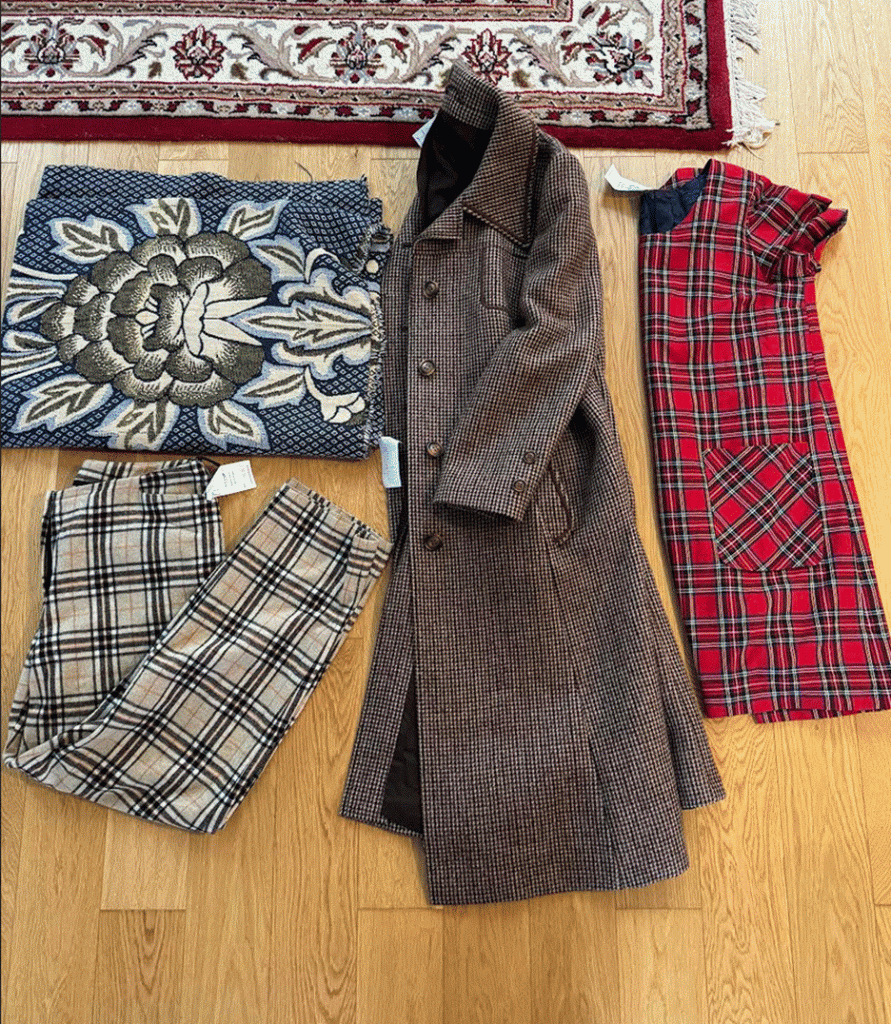
One of my favorite thrift hauls! If you’re patient and go in with a clear vision, you’ll find plenty of hidden gems at your local secondhand store.
I also have gotten into the habit of repairing my clothes instead of tossing them once a hole develops or a seam rips. Learning to sew by hand is a useful skill, and not as intimidating as it may seem. There are countless tutorials for how to mend clothes, and even ones that have fun patterns or designs. This both extends the life of your clothes and gives you the opportunity to add some extra personality to much beloved items.
Overall, these actions have really helped me feel like I’m taking action on climate change. Additionally, they have saved me quite a bit of money, since I’m no longer buying meat (which can be pretty expensive compared to vegetable-based proteins), paying for gas, or buying clothes that fall apart after two washes. They’re also very easy to implement and have changed the way I think about the world and how I interact with the environment. If you’re concerned about the global climate, consider implementing these practices into your own life!
All images are the author’s own unless specified otherwise.
Sources:
- ScienceAdvances (click here)
- UCAR (click here)
- EPA (click here)
- UCLA (click here)
- European Parliament (click here)
- UCLA Health (click here)
- Economics Observatory (click here)
- Sustainability Directory (click here)
- European Environment Agency (click here)
- Lucid Collective (click here)




Leave a Reply