

As a University of Tartu BSc Science and Technology student, you have the opportunity to join the university’s iGEM team, Estonia-TUBI. iGEM is the largest synthetic biology competition in the world.
Never Heard of Synthetic Biology?
In a nutshell, it is an emerging field in biology where you engineer living systems and organisms to benefit us. As you probably learned in high school, every organism has a genome that carries its genetic information. DNA is like a memory chip; it stores your traits so you keep your shape. It’s what stops us from randomly growing wings. Now, let’s imagine you can somehow insert a special gene, which allows you to grow wings, into your genome. This is the idea of synthetic biology. But first of all, I think not many people want to look like angels, and second of all, it is not possible! (at least with the current level of science). Instead, we can manipulate genomes in simple microorganisms.

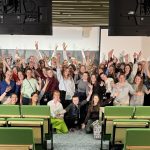
iGEM team in a synthetic biology lab. Photo credits: iGEM Foundation (click here to read more)
Why Would We Want To Do That?
Take malaria for example. It is an infectious disease caused by parasites. In 2023, 263 million cases worldwide caused an estimated 597,000 deaths. Scientists found out that a compound, Artemisinin, is effective against the parasites. However, it was extracted from plants in tiny amounts. This was where synthetic biology came into play: synthetic biologists inserted the genes into yeast, which produced the compound for us. To be precise, yeast did not make the actual compound but rather its precursors.
Of course, biology is not always straightforward, and you will definitely need to overcome several obstacles. But recent discoveries show promising results of this approach. And you can take part in it at our university.
Our Project and Journey

Me when I was making my custom microbial fuel cells for experiments.
Our project started at the end of the spring semester. After reviewing the papers and discussing with our faculty, we decided to develop microbial fuel cells. Microbial fuel cells, unlike conventional battery cells, generate electricity from living microorganisms rather than chemical reactions. Extracting electricity from organisms is actually not complicated; you feed sugars to microorganisms, and they give electrons to us. However, natural non-engineered strains do not produce high amounts of electrons. Here, synthetic biology comes into play again. We identified why we could not extract many electrons: microorganisms consume them to survive. Specific reactions consume them significantly. To tackle this issue, we engineered yeast genes to inhibit these reactions. In the end, we successfully reduced the amount of electron consumption as we expected.


Me measuring the voltage by changing resistance.
To evaluate the results, we also developed our own battery cells. In Science and Technology, you choose a specialisation out of three options: Bioengineering and Robotics, Genetics and Biotechnology, and Chemistry and Materials Sciences. In Bioengineering and Robotics, you not only study biology but also take engineering courses such as Computer-Aided Design and Technical Graphics to design products using computers. Thanks to these courses, I managed to design and build battery cells. After measuring the voltage and current of the battery cells, we confirmed that our engineered organisms produce more electrical power than non-engineered yeast.
Our team’s achievements went beyond lab work and included organising a summer school, designing a website, and more. iGEM not only evaluates your lab performance but also all the aforementioned aspects, because its purpose is to spread synthetic biology worldwide. You will have the opportunity to teach synthetic biology to locals and high schoolers. And even if you do not join the team, you will still be able to have the same experience in Synthetic Biology Lab courses in Bioengineering and Robotics specialisation.


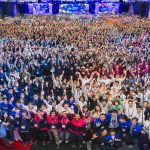
The Grand Jamboree in Paris. Photo credit: iGEM Foundation.
Lastly, at the end of our project, we participated in the Grand Jamboree in Paris for a week to present our project to judges and other biology students from all over the world. You will be amazed by the number of people passionate about changing the world through biology. After participating in the competition, I became more motivated to study biology and to seek challenges to solve using biology.
All images are the author’s own unless specified otherwise.

Leave a Reply