

When I applied to the ENGO program, I honestly wasn’t sure what to expect. My undergraduate degree in dance and astronomy wasn’t exactly directly transferable climate change and environmental policy, and I’d spent the last five or so years working full time. I expected lots of lectures and a handful of seminars. I was right, but I was surprised by the number of field trips – Practical Training in Environmental Monitoring and Sampling had three, alone.
In hindsight, that makes sense; to make the training “practical” it’s best to do it in situ, which means carrying out field work. But I had at least one field trip for almost every class – they ranged from short, local walks in a park to multi-day excursions around the country. Each one brought new insights into how scientists measure habitat change, how policy is implemented, or what you can do with a Master’s in ENGO. Here, I discuss my three favourite field trips and what I learned from them.
Meteorological monitoring at Tõravere weather station with Practical Training in Environmental Monitoring and Sampling
This relatively short trip was definitely a highlight of my semester. A 30-minute bus ride brought us to the Tõravere weather station located on the grounds of the Tartu Observatory. The campus was fairly rural, with open fields, a smattering of trees, and at least seven small observatories housing telescopes of varying sizes. While the astronomer in me was delighted to be on familiar turf, the class was directed to a small building about a minute walk from the main observatory. We were greeted by one of the weather station staff and brought to an open field behind the station that was filled with meteorological equipment.
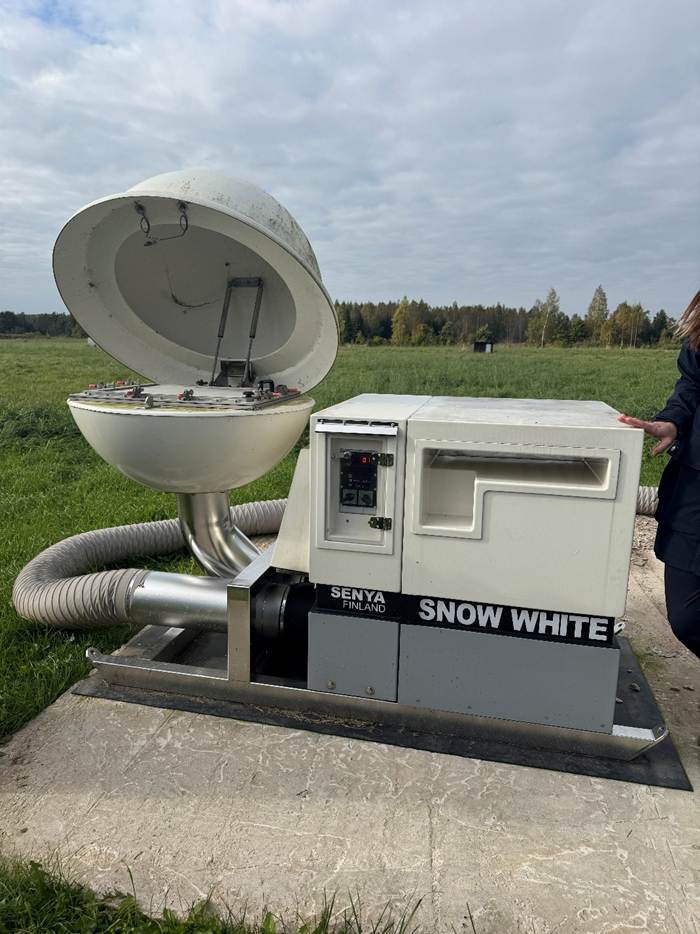
The Snow White: a modern air sampler for radiation detection.
The field was a veritable museum of meteorological science, with measuring equipment spread out. Most of the equipment is now outdated, with measurements being taken remotely with multi-functional machinery. However, being able to see the old equipment and learn how meteorological monitoring and sampling began was useful to understanding not just how the measurements are made, but why we use certain units and how they’re measured. This knowledge came in useful in another class, Atmospheric and Climate Sciences, where we learned to synthesize these measurements into weather reports.
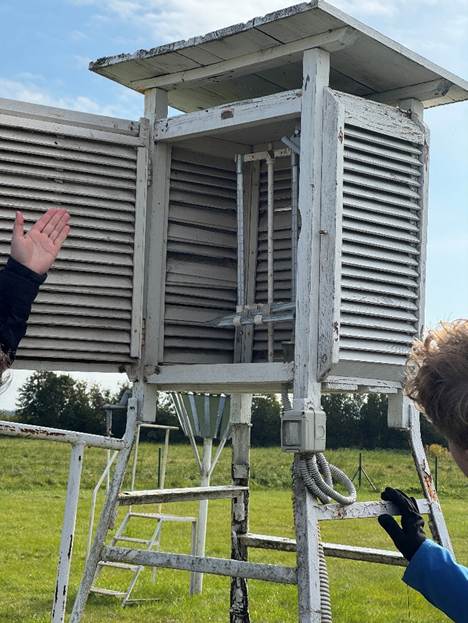
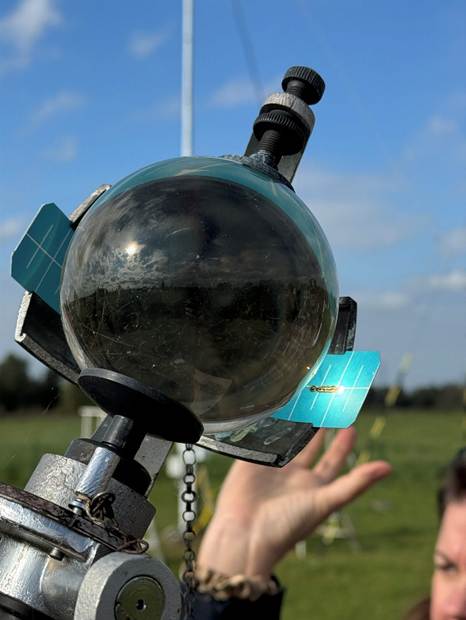
Old meteorological equipment. Left: an old thermometer, kept 2 meters above the ground in a south-facing box to ensure an accurate reading. Right: a Campbell-Stokes sunshine recorder, a glass globe that focuses sunlight on a strip of paper, burning the paper in a line to mark the hours of direct sunlight.
It was also interesting to see how the instruments have changed over time. As I mentioned earlier, much of the measurements are now taken remotely, using digital scales and sensors to take ultra-precise readings. But for educational purposes, the Tõravere station keeps older devices. From an old mercury thermometer to a simple bucket, to varying styles of weather vanes, it was humbling to imagine someone going out to take manual measurements every couple of hours or so, no matter what the weather was like. It makes me grateful to live in an era of such technology.
Cultural and environmental intersections with Estonian Cultural Landscapes
The longest trip by far, this two-and-a-half-day excursion to the island of Hiiumaa was the most exciting. We left in mid-afternoon on a Thursday and returned late in the evening on Saturday, about one month into the semester. The first night was spent at a spa hotel in Haapsalu – one night of luxury (and sauna!) before spending the next two days touring Hiiumaa and learning about local ecology and culture.
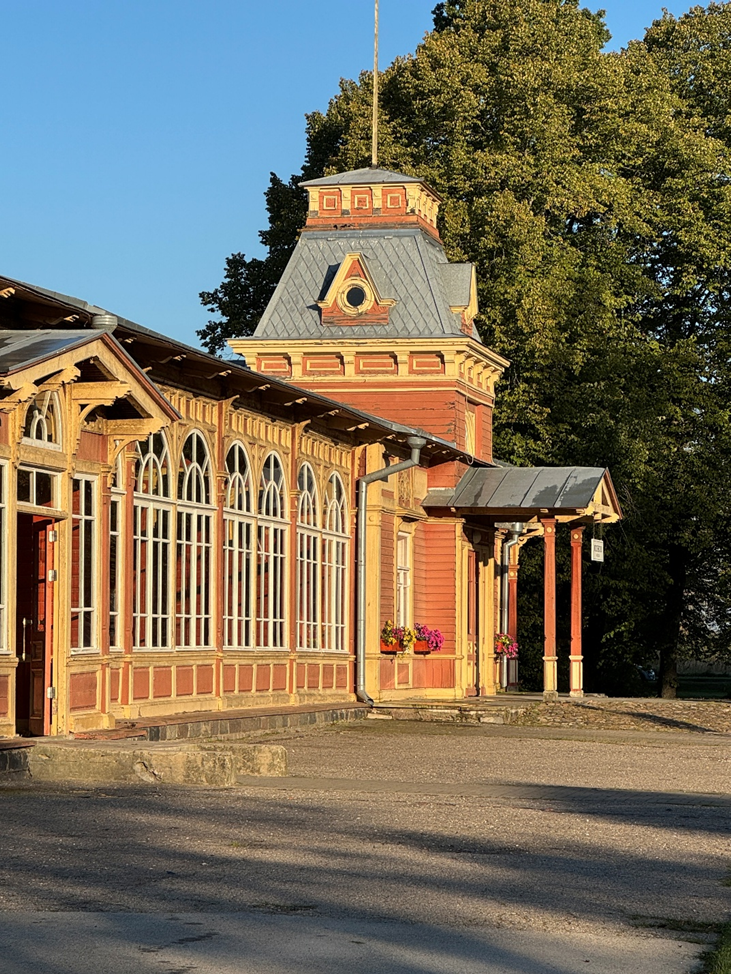
The Haapsalu railway station. This station was built in 1904 and used by many people (including the Russian tsar) to visit the healing spas in Haapsalu. It was later used for deportations during the occupations, and was finally shut down in 2004.
After taking the ferry crossing the next day, we picked up a local tour guide. He was very knowledgeable about the history of the island and its local ecology. He brought us to culturally significant buildings, like lighthouses and a homestead-turned-museum, an old Soviet military bunker, and local parks that showcased unique, Estonian ecosystems. This field trip was a lesson in Estonian culture, history, and environment, all of which inform how the country is addressing and adapting to a changing climate. We learned about preservation efforts to save alvars, semi-natural grasslands with some of the most biodiversity in the world that require human influence to stay healthy. We visited the (former) island of Kassari, where the lagoon separating it from Hiiumaa is disappearing due to continental uplifting. Despite efforts to keep it flooded, it is slowly turning into grassland, creating a new habitat and bringing new challenges to the surrounding communities, who have historically relied on the lagoon for fishing.
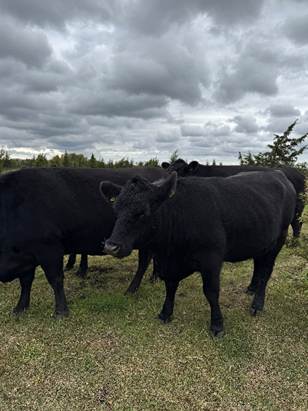
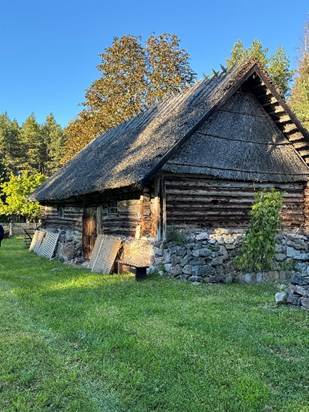
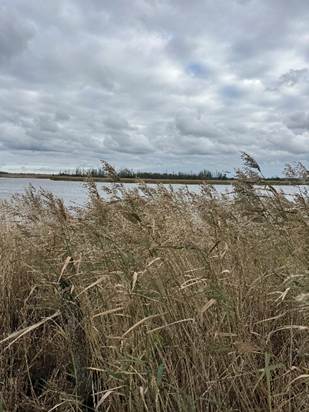
From left: 1. Cows, important for keeping trees at bay in a semi-natural Alvar. 2. An historic farm house, situated on land abutting a forest so its inhabitants can both farm and forage. 3. Reeds growing in the shrinking lagoon between Kassari and Hiiumaa.
Shortly after this trip, I learned that my grandfather’s family was from Hiiumaa, making the trip extra special to me.
Policy in action with Environmental Management and Policy
This day trip was a lesson in degree application. We visited three sites: the Tartu water treatment centre, a recycle sorting facility, and Estiko, a plastics/packaging/real estate management company.
The water treatment plant illustrated the importance of policy and resource management. Most of Tartu’s water supply comes from groundwater, which can often be contaminated by agricultural and industrial runoff. To make sure it’s safe for human consumption and that used water can be returned to nature uncontaminated, it goes through a rigorous process of filtering and cleaning. We were given an overview of the process and how water flow and use is managed within Tartu. Then, we had a “lovely” tour of the facilities (I recommend wearing clothes you aren’t emotionally attached to and a mask). Getting to see the whole process in action was fun, but I did shower and run a load of laundry as soon as I got home.
The recycle sorting centre was similar. We toured the facility and watched as paper was sorted by type. We were shown how plastics are separated and bundled, and explained how the recycling scheme in Tartu works. This part of the day was interesting, but very loud, so I didn’t hear much of what was happening.
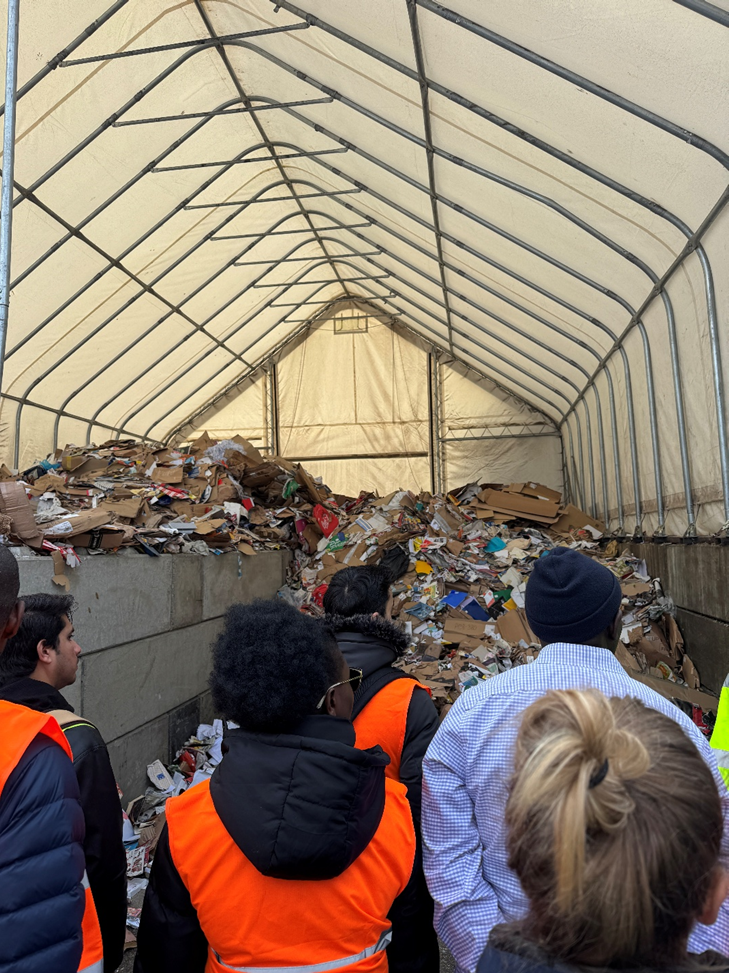
Classmates listening to an explanation of the sorting process.
Finally, we ended the day at Estiko. It seems counter-intuitive to visit a plastic factory when plastics are a known pollutant and environmental groups are trying to convince people to stop using plastic. However, plastic isn’t going anywhere yet, and Estiko is very aware of their environmental footprint. They actively work to make sure they are mitigating the effects of their manufacturing as much as possible. Their factory runs almost entirely on solar power, and they have installed special filters in their chimneys/exhaust pipes to prevent small-particle and toxic gas from polluting the surrounding neighbourhood. As one of the largest producers of plastic packaging in the Baltics, their dedication to sustainability is admirable.
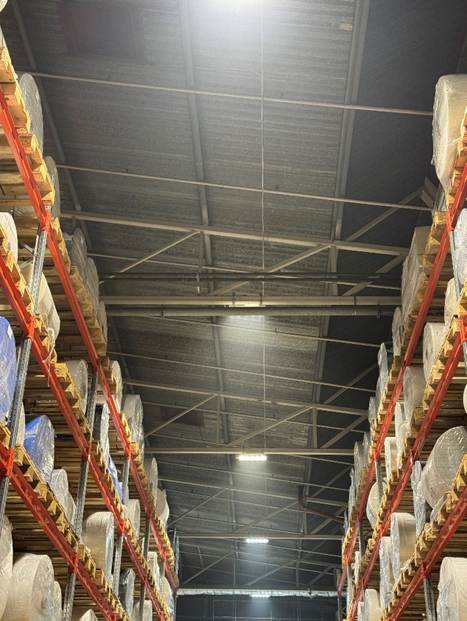
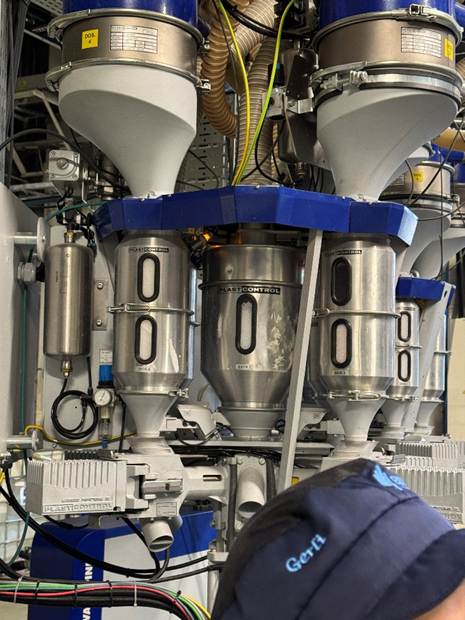
Scenes from the Estiko factory. Left: rolls of unprocessed plastic. Right: an extruder that processes thousands of meters per second.
Takeaway
Overall, these field trips resulted in a lot of new knowledge. From practical applications, to cultural and environmental context, to future professions, I came away with a better understanding of my degree and its purpose in today’s world. As someone who has always needed to move and be hands-on in my studies (see: dance major), the number of opportunities to engage in hands-on learning has been highly beneficial to me. Lectures and seminars have their place, but being able to see what we’re studying in a real-world context has helped to make me feel more confident in my understanding of the course material and given me a clearer path forward into the future.
All photos taken by the author.

Leave a Reply