

Two Sundays ago, on the 9th November, my household was greeted by fourteen masked sandid (mummers). They arrived at our door, sang us three regilaulud, made us dance, drank my beer, took my lollies, blessed our house, and left with a broken clock. These people weren’t strangers to me, however. They were members of the NEFA Folklore Society taking part in their annual jooks, a mumming run timed with the two main Estonian masking holidays, Mardipäev and Kadripäev. Last year our ambassador Dimitris wrote about what Halloween looks like in Estonia. (click here). This time, however, I want to put my Folkloristics hat on to look more closely at Kadripäev traditions alongside some interesting connections to our University and parallels with contemporary drag in Tartu.
But, to begin, it might be helpful if I explain what Kadripäev, mumming and regilaulud actually are first.
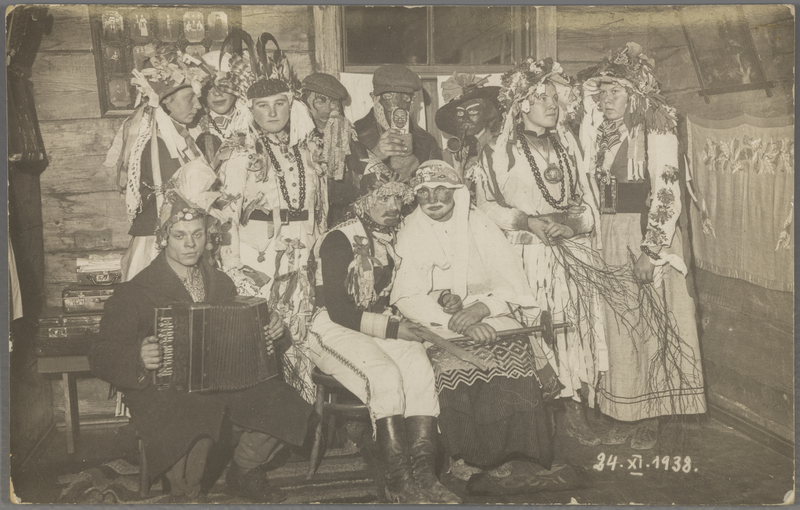
Laimjala vallast Kinglist ja Audlast. 24.11.1938 (SM F 3641_11)
The Day’s Origins
Kadripäev (“St Catherine’s Day”), is an Estonian rahvatähtpäev “folk holiday” with very old roots reaching back to around the 10th century as a Church holiday and by the 16th century it had begun to resemble the medieval European Feast of Saint Catherine. The Saint in question, Catherine of Alexandria, is associated with spinning, craftsmanship, women in childbirth and the protection of animals, which for the agricultural Estonian people, was a huge deal!
There is some debate about whether this day might also refer to Martin Luther’s wife, Katharina, who was once described as a beggar like her husband.
Anyway, in this part of Europe, Estonia to be exact, late autumn festivals acted as one of many seasonal markers telling people to transition from outdoor fieldwork to indoor tasks. Something I can relate to this a bit too well with my shift to thesis writing now. The day also came with rules and work bans, especially relating to wool. Work involving wool was forbidden due to a belief that it could lead to blindness or weakness within the flock. Other rituals varied by region but some examples are:
- Entering a room in pairs. Believed to bring twin lambs the following year.
- Eating the feast in the barn. Thought to give the animals strength.
- Burying chicken bones in the manure. Ensured good luck.
- Eating cabbage soup was banned as it may inspire your chickens to eat the growing cabbage in the following Spring.
What to Expect When They Come Knocking

The “runners” form a group of performers (children, young people and adults alike) known as a kadripere, a “Kadri family” led by a kadriema. In the past, this family would comprise mostly of disguised animals (like a goose, bear, stork, goat) however by 18th-19th Century people started dressed in white, feminine clothing with bright red cheeks, they were the counterpart to the rougher, masculine and beast-like mardisandid of St Martin’s Day. The white is said to represent either purity or milk, which links back to cattle breeding and a legend in which a milk-like substance flowed from Catherine’s neck instead of blood when she was martyred in the 4th century. Also, I almost forgot to mention that among the kadrid, there are disguises of a young man with a peeing baby made of straw, along with a goose. Don’t ask.
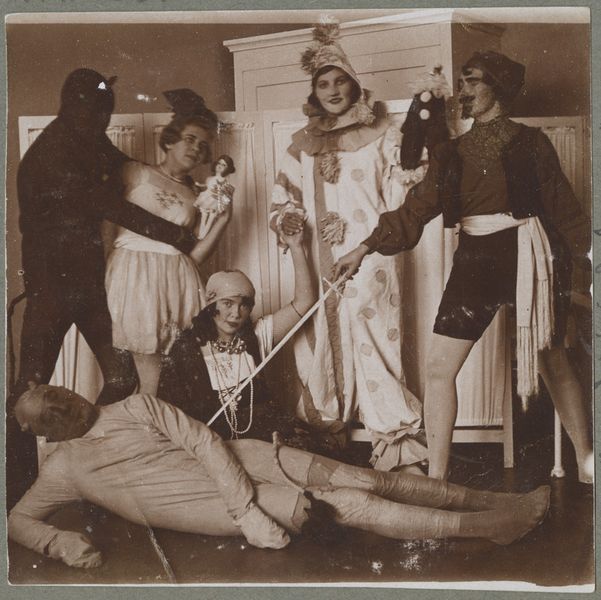
Taagepera sanatoorium, Peeter Vabriti 10.11.1929 (VMVMF591_15F)
These sandid ask to enter people’s homes to sing regilaulud “runo songs” (an ancient call & response song/chant), tell mõistatused “riddles”, and play games in exchange for gifts. Traditionally speaking, said gifts would be wool and food, but nowadays it is more like lollies and sometimes loose change. They might also scatter grains or spray water around the house, just for fun. In case you have a herd of sheep lying around, they would also be blessed.
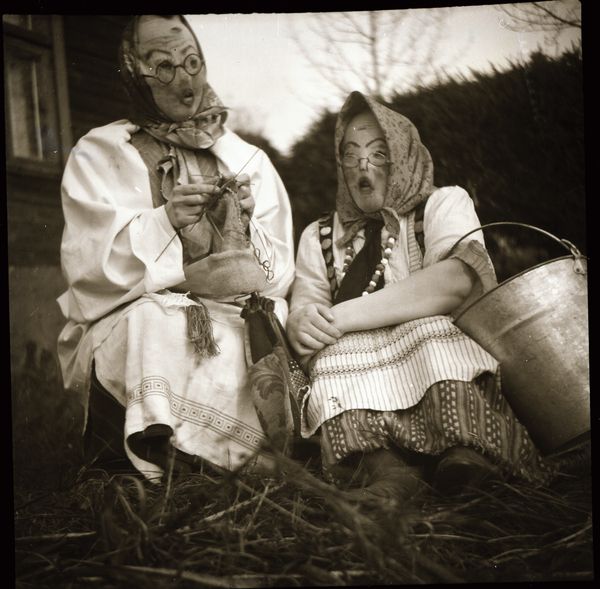
25.11.1953. Häädemeeste piirkonnas pildistatud kadrisandid. Eesti Rahvaluule Arhiiv (ERA 2767) Aleksander Jaaksoo
Although more than fifteen of these mumming holidays once existed, Kadripäev is said to be one of three surviving traditions in Estonia popular today. With the 20th century came more people wanting to wear anthropomorphic masks and dress as human figures – especially men, who started dressing as women during mumming runs. Ongoing attempts to Its revival today is in part due to the Estonian Folklore Council, the Estonian Centre of Folk Culture and especially the Hakkame Santima (find more information about it here) campaign which documents and promotes these traditions. As of this year the Ministry for Culture and the Estonian Folklore Council also put forward these masquerade traditions for listing in the UNESCO Intangible Cultural Heritage inventory.
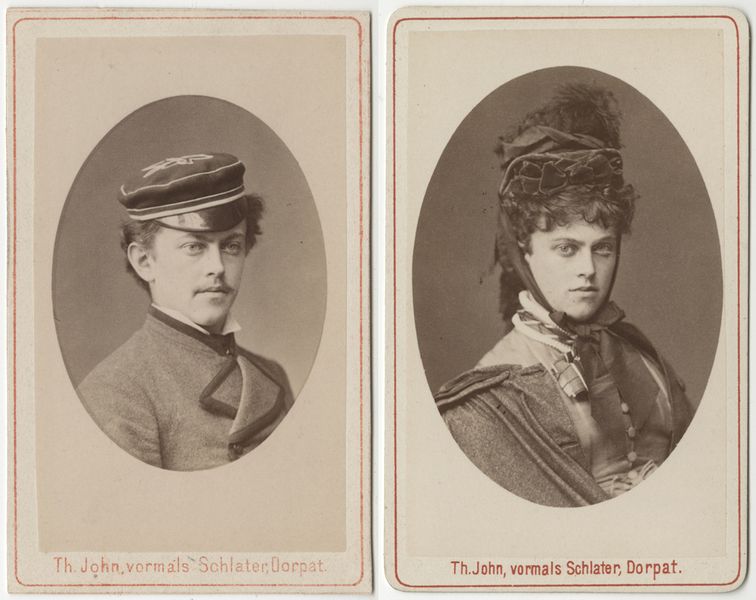
This brings me to a historical example of drag practices from our very own University of Tartu. There are records showing that Baltic-German male korporants (those “frat bros” with the fancy suits and hats, sometimes a rapier too) at the University used to dress up as women. Photos from the 1870s to the 1890s show rebased (uninitiated korporants) posing alongside their female alter egos whom they played in productions known as “pledge theatre.” These images were often turned into cartes de visite as keepsakes. Some of the plays referenced in the photos include A Midsummer Night’s Dream and The Sunken Bell (Die versunkene Glocke). You can have a look at these photos here.
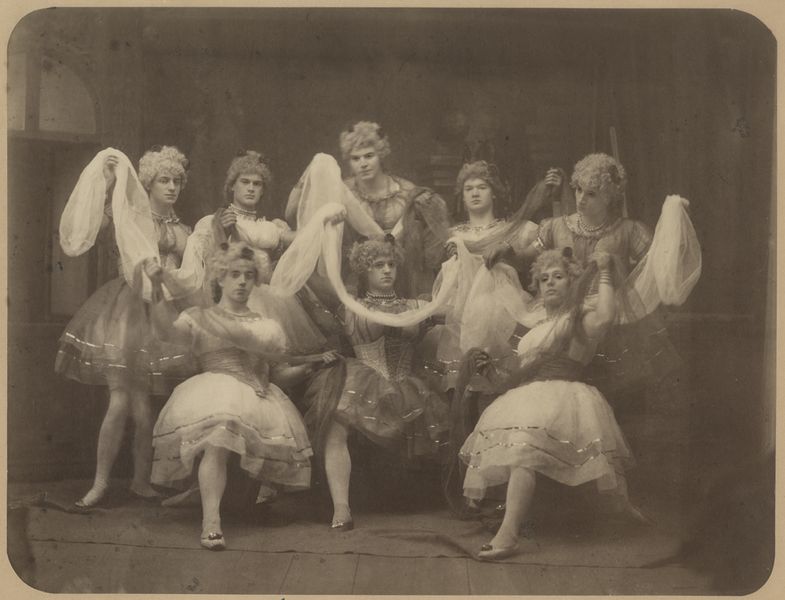
This practice continued for several decades. With the University admitted only men, and the korps! also remained male-only until 1920, any play requiring female roles had to be performed by male rebased. This began to shift in 1905 when women were finally allowed to attend lectures, although they were not admitted as full students until 1915. Even then, the Corporations stayed male-only until 1920, so stage productions still relied on men to put on the dress.
You might be thinking that this was simply a misogynistic tradition within Baltic-German student culture. In my view, however, these performances drew on deeper customs and values. Drag never disappeared in Estonia and, from what I have seen, it has only become more professionalised and popular.
Past to Present Day
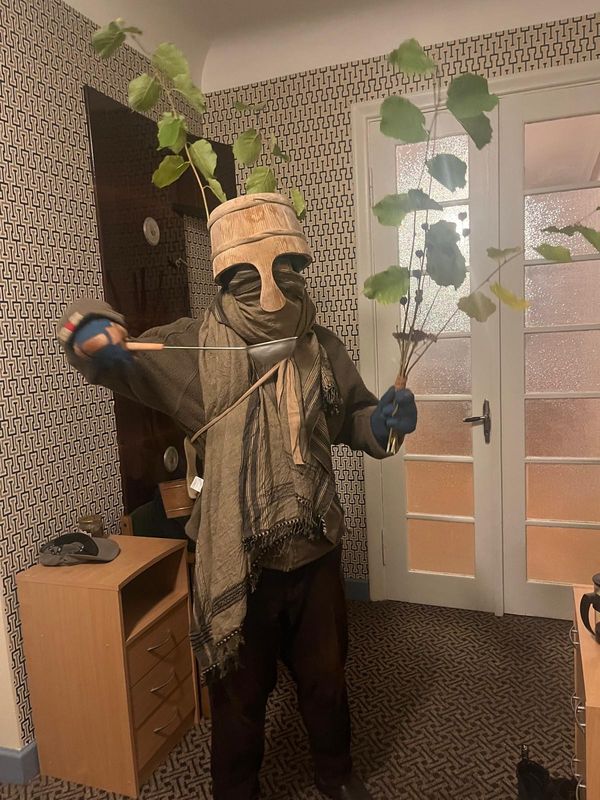
Thinking of this past and the NEFA jooks, it was interesting to see the historical parallels. I first got to “do” Mardipäev and Kadripäev last year with both my folkdance group, Leigarid, and NEFA. As a mart, I became a saunamart or vihamart (sauna-whisk Mart) and as a kadri I became a pesukadri (washer-Kadri) – inspired by a family-friend who’d just defended her thesis at the Estonian Academy of Arts. Putting theory into practice, creating these alter-egos was such a fun opportunity to raid my housemates wardrobe and break out of the rigid gender norms I grew up with in the diaspora. In the spirit of tradition, these DIY costumes and roles or personas I came up with, reminded me of the creativity I can also see reflected in the drag scene of Tartu.
My first drag show in Tartu was at Aparaaditehas in the Summer of 2023, when Kogo Gallery hosted the Baltic Drag King Collective. As an introduction to Baltic drag, the community and the energy, despite this region’s small size, was palpable. Coming from Sydney, it was also refreshing seeing so many drag kings and non-binary performers. While drag has its own history and references, especially from the Black American & Latino ballroom scene as well as Elizabethan theatre. I still can’t get these mumming masquerades out of the back of my mind when I look at the growing drag scene happening in Estonia today.
Across the Baltic region, especially Riga and Helsinki, drag performers and experimental artists are back in the limelight. Drag in Estonia is not only entertainment, it’s an identity. And oftentimes, the performances draw on historical and national figures. From Kalevipoeg to Lydia Koidula, to caricatures of Riigikogu politicians. Likewise, last year at the “Kellele kuulub öö?” exhibition at the Estonian National Museum, a short film titled Lillade õuduste öö (Night of Purple Horrors), examined the history of drag and gender non-conformity in the 1930s to today amongst the backdrop of nightlife throughout the ages.
This lineage of mumming, cross-dressing and drag might be an unconventional way of viewing these practices, but I don’t think it’s a stretch. All rely on humour, caricature, DIY and the playful testing of social norms. A kadripere travelling house to house resembles a drag House in form with their parental “Mothers” and “Father” parents guiding their younger members. They perform together, they improvise, perform for small gifts (mostly cash). It carries the same spirit even when the materials and contexts have changed.
Estonian and Baltic drag has grown significantly in the past decade. In Tartu, some performing Houses to keep an eye out for include performers associated with the House of Kuko, The House of Tools as well as independent solo acts. In Tallinn, The House of Danger has a long history with the scene especially with their infamous BÄM! parties!
If you are looking for drag in Tartu there are several stages, though dedicated venues are lacking. Places I’ve seen include things like Genialistide Klubi (as part of their Vikerruum series), Kogo Gallery, Karlova Teater, and Elektriteater (as part of the Festheart queer film festival). Peemoti Keskus (Behemoth’s Centre) in Tartu also helps organise and support the queer youth community. Tallinn’s scene revolves around places like Sveta Baar and Heldeke as well as cultural venues such as Paavli Kultuurivabrik and Kanuti Gildi SAAL.
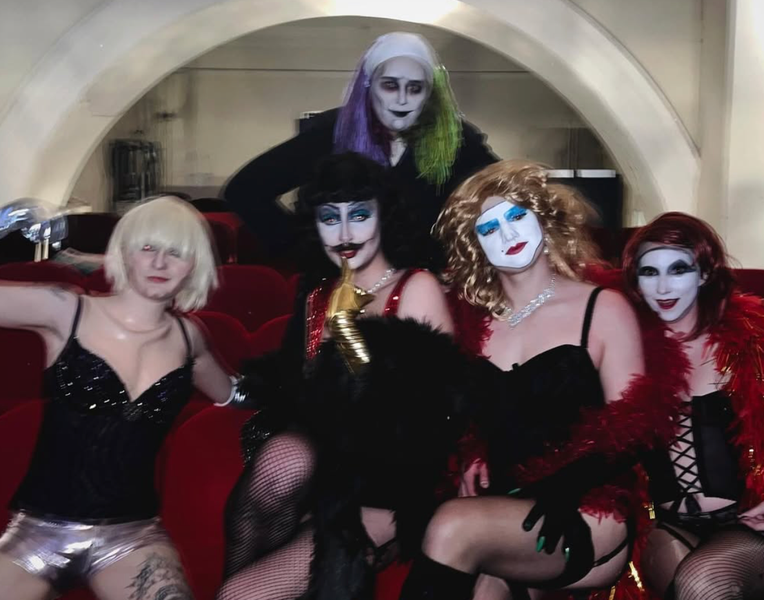
Photo taken from House of Kuko’s Instagram page @house.of.kuko for the screening at Elektriteater of the “Rocky Horror Picture Show”
I want to suggest that this recent wave of drag reflects a desire for the carnivalesque and surreal that older folk holidays once normalised. Masking traditions once offered an escape from ordinary rules. Strangers could enter your home, throw peas and wheat grains on your floor, sing to you, bless your animals and leave with an apple or more. Drag today undeniably draws from many references, historically also from underground ballroom African-American & Latinx culture. For many of these performers though it is not a costume, it is their life and their expression of something deeper. It is also a political act. It continues a long tradition of masking and transformation that is far older than modern drag itself.


Leave a Reply